
Every year, one operation sets the benchmark for flawless global execution: the Christmas Eve delivery run.
It is precise, resilient and delivered without fail. Santa may call it “Christmas magic”, but Mrs Claus, Chief Operating Officer at the North Pole, knows the real reason. Their success rests on disciplined controls assurance.
Her approach shows that reliability is never accidental. Whether managing a sleigh route or a complex organisation, consistent outcomes depend on understanding your objectives, knowing where things can go wrong and being confident your controls will perform when needed.
For practical guidance on building and strengthening your own controls framework, download our Mastering controls for risk management eBook.

Begin with the end in mind
Mrs Claus’ first tip is to focus on the magic. She points to two objectives related to the annual present drop:
- Deliver every toy on time
- Deliver toys that children will enjoy.
Controls assurance is all about being confident that these objectives will be met. The link to objectives makes controls enablers, not hindrances.
Next Mrs Claus outlines that you need a good understanding of your critical operations and processes. She pulls out a service map (the same one she showed us a few years back when demonstrating how operationally resilient Christmas is).
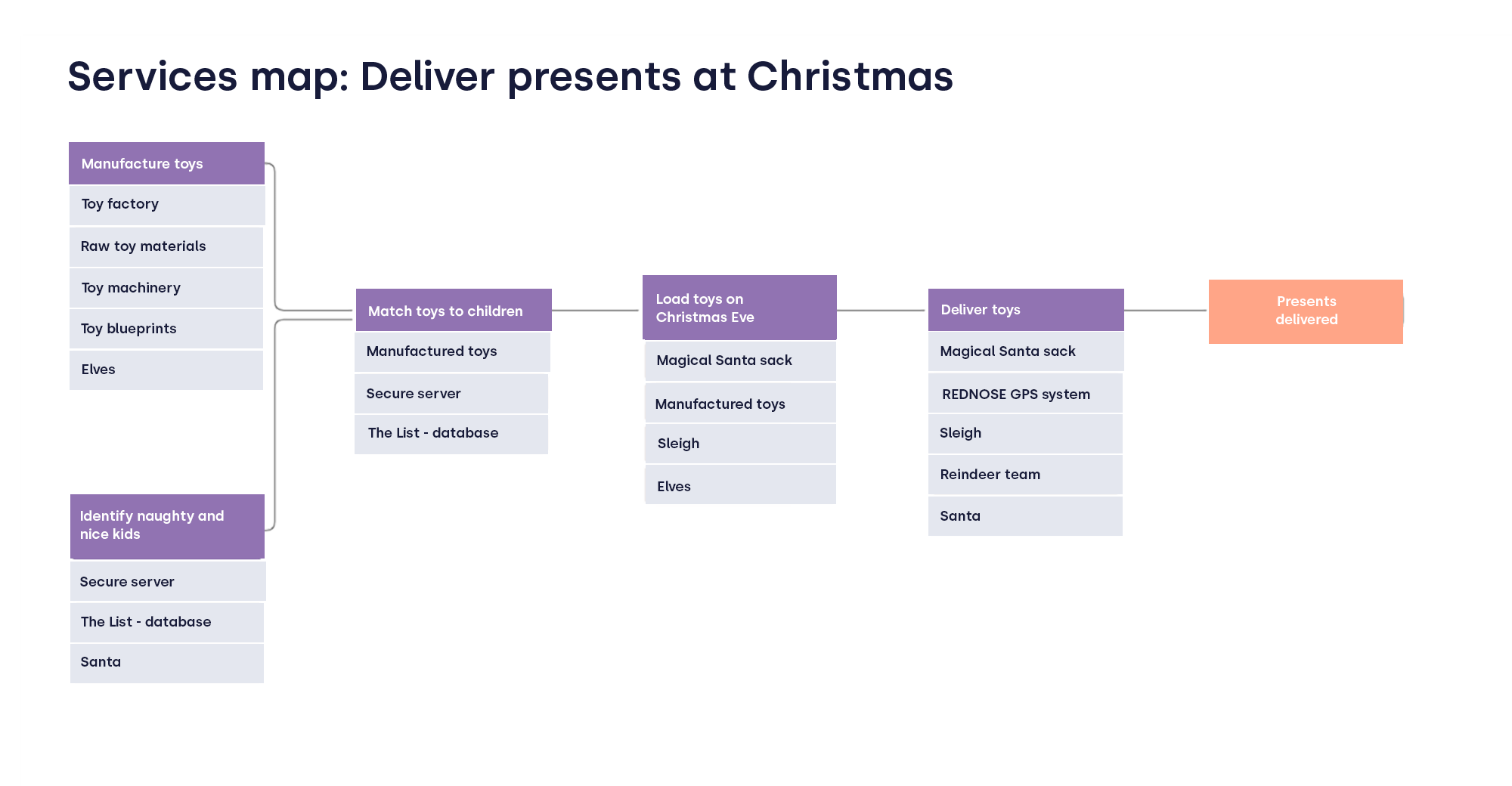 Understand what you are managing
Next comes a risk and control-self assessment. Risks (potential events or conditions that could result in failure to achieve the objectives) include:
- Inaccurate Naughty and Nice list: caused by data entry human elf error, buggy integrations, or over-reliance on Santa’s ‘gut feel’
- Unauthorised manipulation of the Naughty and Nice list: Naughty Listers try to prank their siblings, or Santa accidentally promoting children who left the best cookies last year
- Inability to navigate sleigh route: the Grinch might hack the REDNOSE GPS system
- Faulty or poor-quality toys delivered: misaligned toy inspection processes, untested toy spells, or elves skipping QA for cocoa breaks.
- Sleigh failure mid-flight: cracked runners, worn-out harnesses, or insufficient magical reinforcement due to budget cuts in the Sparkle Division.
- Incorrect or missed deliveries: misdirected gifts or duplicate presents (or Santa partaking in too many mantlepiece sherries)
- Supply chain disruption: shortages of raw materials or batteries (Mrs Claus isn’t as worried about supply chain disruption these days, given she already implemented strong vendor risk management).
Mrs Claus pays a lot of attention to the Naughty and Nice list. If those records are inaccurate, every child might get the wrong present, resulting in catastrophic failure of one of the objectives. This importance drives the frequency and rigour of the control's assurance program. While all controls have some level of assurance, those over the Naughty and Nice list are tested far more frequently. Those controls include:
- Data validation rules: spotting contradictory or impossible behaviour
- Segregation of duties: behavioural data collected by Elves on the ground are reviewed by a second team before being integrated into the List to identify anomalies
- Exception reporting: the Assurance Unit reviews all children’s behavioural metrics to ensure they are consistent, focusing on big swings or suspicious change in behaviour
- Access controls: prevent unauthorised access to the List (Santa wants to maintain it himself, but Mrs Claus just says, ‘key person risk’).
Effective controls test design
Mrs Claus recommends three components for an effective control test:
- Control objective: A clear understanding of why the control exists and how it is meant to modify one or more risks
- Design effectiveness: Testing whether the control, as designed, is capable of achieving its objectives
- Operating effectiveness: Testing whether the control, even if designed effectively, is actually operating as intended.
Santa enthusiastically chimes in: “We did some sampling of how many children complained last year. Only three kids complained! This year is looking good”.
Another eye roll, and Santa becomes suitably distracted after Mrs Claus hands him a biscuit.
“Past results tell us how well we did last year. It doesn’t give me any confidence about performance this Christmas.”
She then provides a simplified example of a control test.
Table: North Pole control test. Source: Mrs Claus, Christmas 2025
|
Control |
Segregation of duties |
|
Control objective |
To prevent the risk of an inaccurate Naughty and Nice List, in order to reduce the likelihood of the risk occurring. |
|
Control description |
Behavioural data collected by Elves on the ground are reviewed by the Senior Elf Adjudicator Team before being integrated into the List. |
|
Control design test |
|
|
Control operating test |
|
Tinsel, the Elf Assurance Officer, recently tested this control. He was independent of the process, making him an ideal candidate to conduct the testing.
After conducting walkthroughs with his fellow elves, he found that some had shared their passwords with others in order to speed up the process. While there was no evidence children had been misclassified, Mrs Claus’ confidence had been shaken.
She focused on the positive: identifying this issue resulted in continuous improvement and higher level of confidence. Once the weakness was identified, the control was strengthened and elves retrained in its importance.
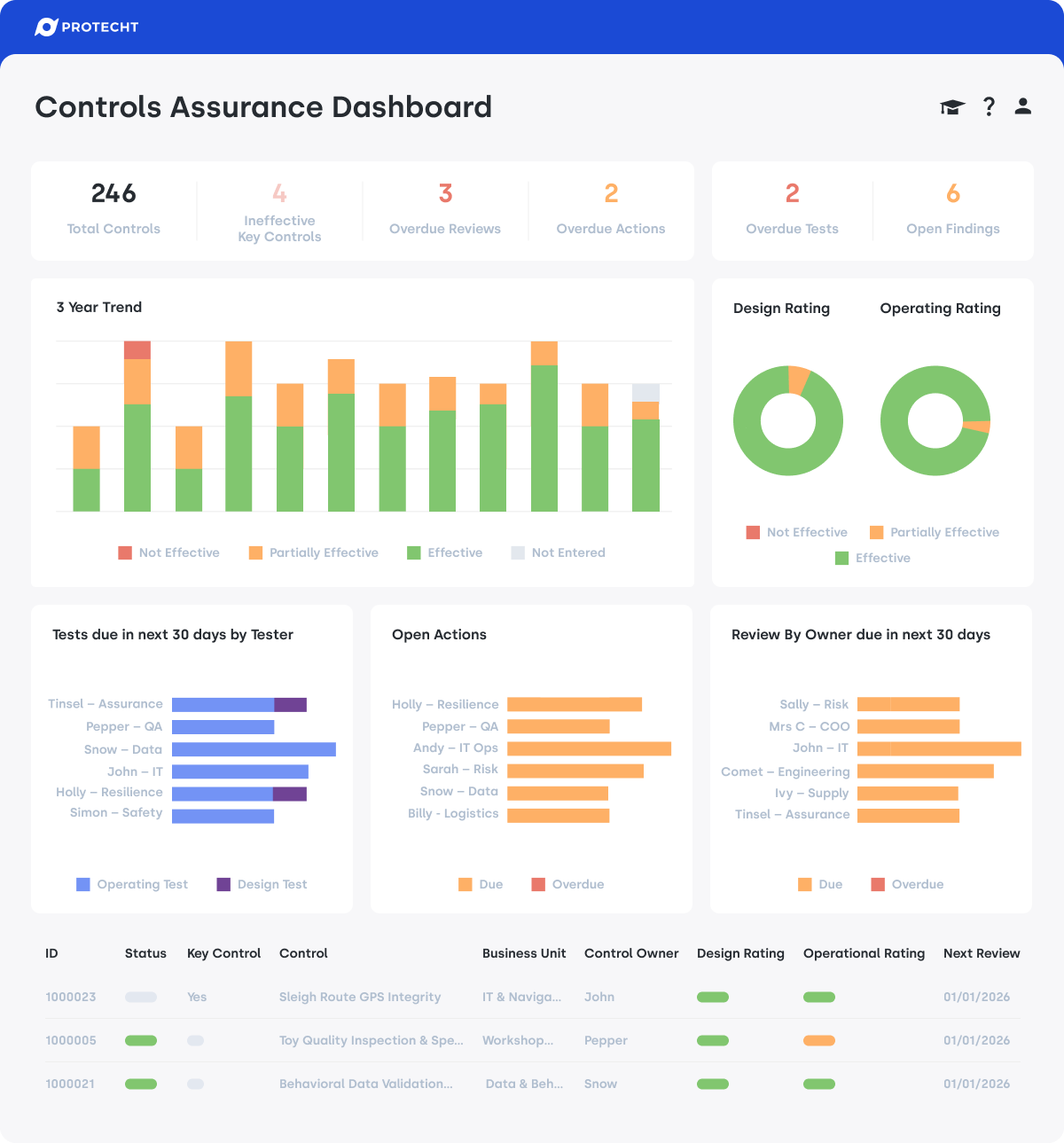
Assurance doesn’t happen over one control in isolation. She flashed up her assurance dashboard: a wall of colour-coded control statuses, test cycles, and upcoming reviews. Everything was on track. Santa gave an impressed whistle; Mrs Claus reminded him that this is what real magic looks like.
See the impact in your own environment
“Historical testing tells you what has happened. Controls assurance provides confidence in the future.” – Mrs Claus, Chief Operating Officer, The North Pole
Effective assurance is not about looking back at what worked last year. It is about demonstrating, continuously and convincingly, that your controls will perform when it matters. That forward-looking confidence is what separates organisations that simply document controls from those that manage them as strategic enablers.
Mrs Claus’s disciplined approach shows why assurance is more than a compliance exercise. It aligns controls to objectives, tests them with rigour, and uses each finding to strengthen performance. The result is operational certainty, reduced surprises and a clear line of sight from risks to outcomes. The same principles apply to any organisation seeking reliability, transparency and trust across its critical processes.
If your teams are relying on scattered spreadsheets, inconsistent testing cycles or manual follow-up, now is the time to modernise. A structured controls assurance program supported by the right technology will give you the clarity and confidence to meet your objectives, without relying on seasonal luck.
To deepen your understanding of how to design, strengthen and assure controls, explore the full guidance in our Mastering controls for risk management eBook. And if you want to discuss how Protecht can help you embed an integrated, real-time controls framework across your organisation, our specialists are ready to help.
