Risky business:
What to do when your GRC tools become the problem.
GRC tools promise clarity - but often create complexity. As systems fragment, visibility drops and confidence erodes. Download the eBook to cut through the noise and build a clearer, more defensible view of risk.
When your GRC tools become the problem, clarity becomes the advantage.
This is no longer a tooling issue. It is an business-wide problem affecting governance, accountability, and decision-making.
This eBook explains why GRC systems reach this point, what effective governance looks like in practice, and how to move from fragmented complexity to clear, traceable, decision-ready risk management.
In this eBook you will learn how to:
-
Identify where fragmented systems reduce visibility and trust
-
Understand why GRC platforms become barriers, not enablers
-
Connect risks, controls, and obligations into a single view
-
Improve traceability to support audit and regulatory expectations
-
Reduce manual effort and reliance on shadow systems
-
Enable faster, more confident decision-making across the business.
Download your free copy now!
You’ll see how fragmented GRC systems create delays, reduce trust in data, and make decision-making harder than it should be. More importantly, you’ll learn how to move towards connected, traceable risk management that supports faster, more confident decisions.
If this reflects your current challenges, the next step is to see how this works in practice.
Comparing your options
Move from reactive, spreadsheet-based compliance to a connected, automated governance system - ready for the Aged Care Act 2024.
| Capabilities | Manual approach using spreadsheets | Protecht | ||
|---|---|---|---|---|
|
Incident & SIRS management
|
Incidents tracked manually, inconsistent categorisation, limited visibility, and no automated escalation. | Real-time logging and automated escalation aligned to SIRS, with full audit trails and reporting. | ||
|
Compliance & governance reporting
|
Separate spreadsheets per site; time-consuming updates; high audit risk. | Centralised dashboards and reports showing compliance across all facilities, in real time. | ||
|
Risk & quality oversight
|
Disconnected risk registers make trend analysis and board reporting difficult. | Integrated risk framework connecting controls, incidents, and actions to deliver organisation-wide visibility. | ||
|
Audit readiness
|
Manual evidence gathering across documents and emails - error-prone and stressful. | Pre-configured, auditable registers with one-click reporting and timestamped compliance evidence. | ||
|
Workflow & accountability
|
No clear ownership or task tracking; actions often lost in email. | Automated workflows with defined responsibilities, due dates, and escalation paths. | ||
|
Data security & integrity
|
Version control issues and risk of accidental data loss or breaches. | Secure, cloud-hosted platform with role-based access, encryption, and complete audit logs. |
KEY AUDIENCES
Who should read this?
|
Audience |
What you will learn |
|---|---|
|
CISOs and cyber security managers |
Get faster clarity on posture, ownership and assurance during incidents and audits. |
|
CROs, Heads of Risk and risk managers |
Connect cyber exposure to enterprise risk and operational impact in plain language. |
|
Compliance, audit and assurance leaders |
Reduce the scramble for evidence with a more repeatable, provable controls story. |
|
Operational resilience and business continuity leaders |
Treat cyber disruption as a continuity test, not just a security event. |
Your GRC tools were meant to simplify risk. Instead, they are slowing decisions, fragmenting information, and eroding confidence across the business.
“When your GRC platform becomes a system of record rather than a system of work, confidence drops. Restoring traceability and connection across risk data is what turns governance back into a decision-making advantage.”
The numbers tell a staggering story:
63%
85%
65%
How Protecht helps
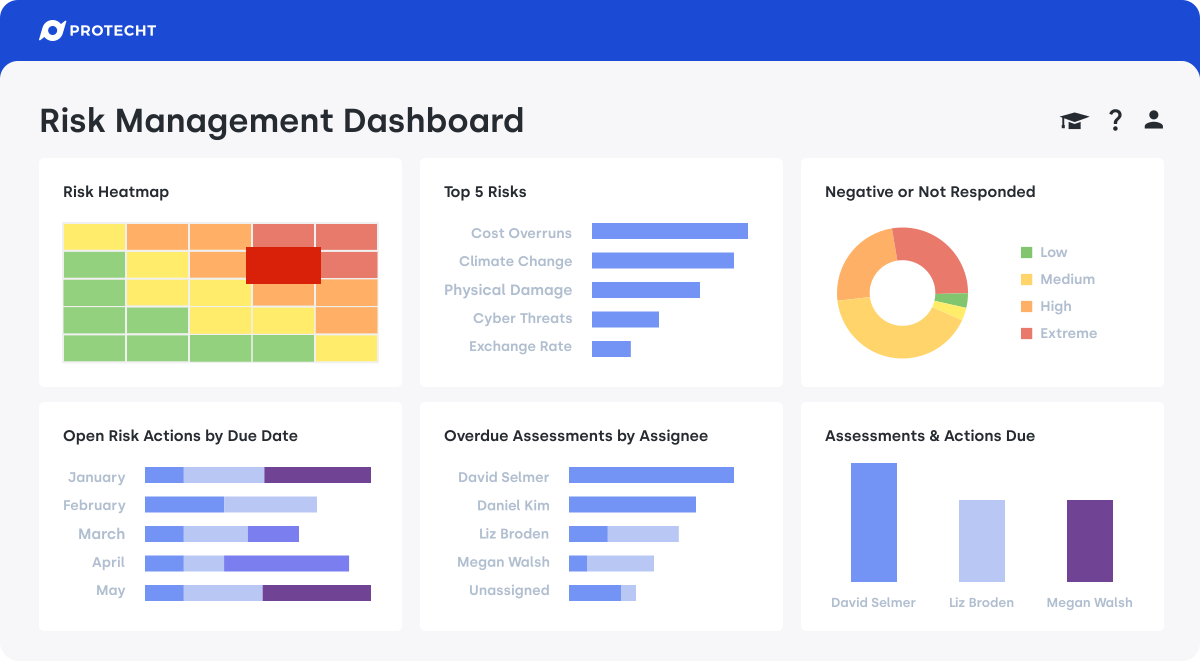
Move faster and make better decisions with a single, connected system for risk, compliance, and assurance.
- Connected data model links risks, controls, obligations, and evidence in one place
- Single source of truth eliminates duplication and conflicting information
- Automated workflows reduce manual effort and reporting delays
- Traceability and auditability improve confidence in governance and oversight
- Integrated reporting and analytics support faster, clearer decision-making