Rethinking RCSA with AI: Better evidence, clearer decisions.
Tuesday 1 December 2026 | 11am-12pm AEDT/GMT/ET (three regional sessions)
An RCSA cycle can finish on time and still leave important questions unanswered. What has changed, what has stayed the same, and why? Which risks need closer attention? Explore how connected risk information and AI can support more focused, consistent and defensible reviews.
Why routine risk reviews can leave questions unanswered
Many RCSA processes generate activity but not always insight. Risk owners can find assessments onerous, highly granular and disconnected from day-to-day decision making, leading to low engagement, variable quality and a tendency toward box-ticking reviews. At the same time, Line 2 teams often struggle to achieve a consistent view of risk across the business.
A stronger approach brings relevant evidence and business context into the review, whether risks sit within one business unit or span several teams and processes. It directs attention where it is most needed and makes the reasoning behind assessments visible. It also gives second-line teams a clearer basis to challenge ratings and understand how the overall risk position is changing.
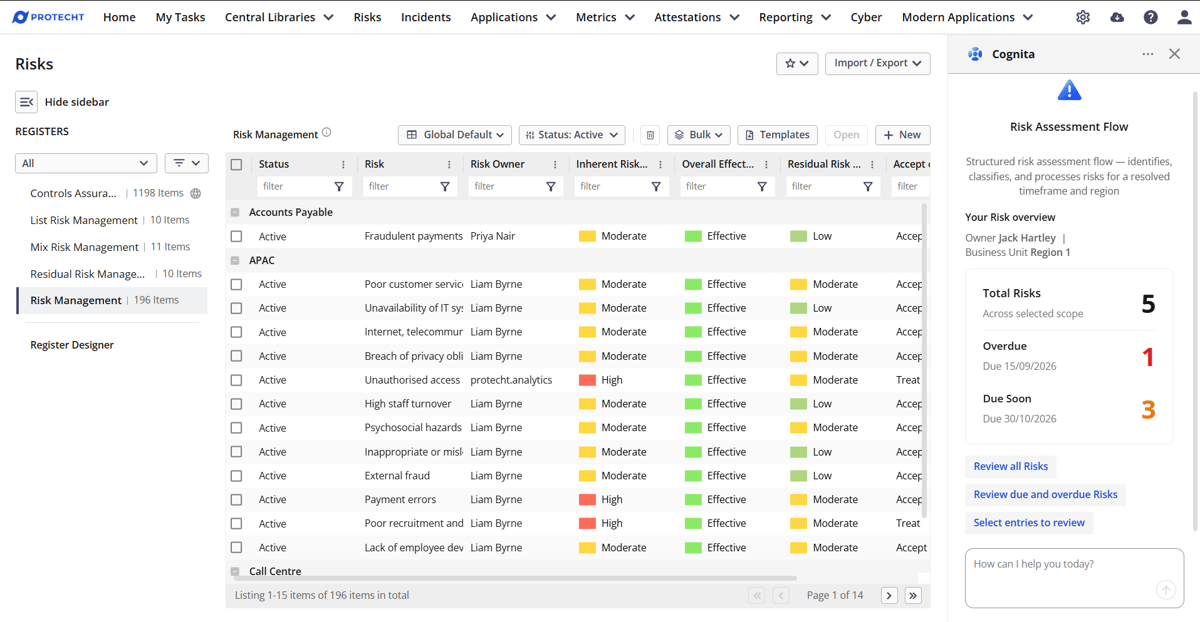
Join Protecht's Michael Howell and Shan Mukerjee to explore what more effective RCSA requires and where AI can help. They will examine the principles of better risk reviews and demonstrate how Cognita, Protecht's AI assistant, guides assessments across multiple existing risks, using connected information to make recommendations that people can accept, edit or reject.
Find out:
-
Identify why repetitive assessments undermine first-line engagement and weaken the value of RCSA
-
Understand how connected risk information can support reviews within business units and across shared processes, supporting both horizontal and vertical views of the business
-
Improve consistency and accountability through clearer assessment logic and recorded reasoning
-
See how AI can guide risk reviews, suggest changes and reduce repetitive work while keeping people responsible for decisions
Register now to secure your place.

Keeping risk assessments relevant as circumstances change
A risk assessment captures a view of risk at a particular point in time, but business conditions continue to change. New incidents, control failures and changes across connected processes may alter exposure long before the next scheduled review. Making assessments easier to revisit, with relevant evidence and business context available, can help risk teams respond more effectively while keeping people accountable for their decisions.
Your presenters
Michael Howell
Michael leads Protecht's risk research and knowledge work, drawing on practical experience across enterprise risk, compliance, assurance and business continuity.
His background includes managing risk functions and implementing enterprise risk management software, giving him a practitioner perspective on what effective risk assessment needs to achieve beyond completing the process.
.png)
Shan Mukerjee
Shan leads Protecht's AI and analytics product work, including Cognita. She brings more than a decade of experience in product strategy and development.
Her work focuses on bringing AI capabilities into practical business workflows. She will demonstrate how Cognita supports guided risk reviews, draws on connected information and keeps users in control of assessment decisions.
Make risk reviews more focused with Protecht
Protecht connects risks, controls, incidents and issues in one platform, helping teams see the wider context behind assessments. Cognita builds on that foundation with AI-assisted reviews of existing risks, helping users focus on material changes and work through explained recommendations while retaining control of the outcome.
Protecht helps teams:
- Review a selected group of risks through one guided conversation.
- Bring related controls, incidents and issues into each assessment.
- Use AI-generated recommendations to support consistent ratings and identify where further review is needed.
- Accept, edit or reject suggested changes, with approved updates recorded for oversight.